Category: SEO

  • How to Write Content For a Website That Ranks On Google

    How to Write Content For a Website That Ranks On Google

    You may know how to write content for a website. But to create high-quality content that ranks high on Google’s SERPs is a different ballgame. It requires an SEO content strategy with target keywords (that aren’t just the highest volume and lowest keyword difficulty), optimization, and unique storytelling for each piece to connect with your audience.

    SEO content writing is a major facet of digital marketing today. If you aren’t writing for search engine optimization and your consumers effectively, your brand is essentially invisible online in a competitive digital market.

    Here’s how to write content for your website to improve its performance in the SERPs and better support your bottom line.

    How to Write Website Content That Ranks

    Brands often make mistakes when writing website content, like spammy sales language in informational blogs or keyword stuffing on service pages that doesn’t sound natural. It can do the opposite of what you’re trying to achieve with your SEO since Google doesn’t reward content that isn’t relevant or helpful.

    While you’re writing content for Google, you must have your audience’s questions, concerns, and pain points in mind to have high-ranking content. Remember, you’re still writing for humans—not just search engines!

    Below is a step-by-step guide on how to write content for a website to achieve higher rankings.

    Create a Content Outline to Structure the Web Page

    Before you begin writing SEO website content, create an outline first. It acts as a template for everything you need from start to finish to ensure you don’t make mistakes or miss any crucial steps along the way.

    Create Your Web Page’s Content Structure

    Whether it’s web copy or a blog post, most SEO content structures are similar in their processes.

    When creating your outline, include the following placeholders to fill in as you go:

    • Title
    • Target and secondary keywords with volume and keyword difficulty
    • Internal links
    • External links
    • Headings
    • Call to action (CTA)
    • Estimated word count

    Content outlines will differ in detail depending on the type you’re creating. For example, product page copy is short-form and will most likely use social proof as their external links. On the other hand, blogs will link to external reputable resources and can be short or long-form.

    Keep in mind that you’ll update this as you go, and an outline shouldn’t be set in stone as you may discover new information when writing.

    Understand Your Content Goals and Target Audience
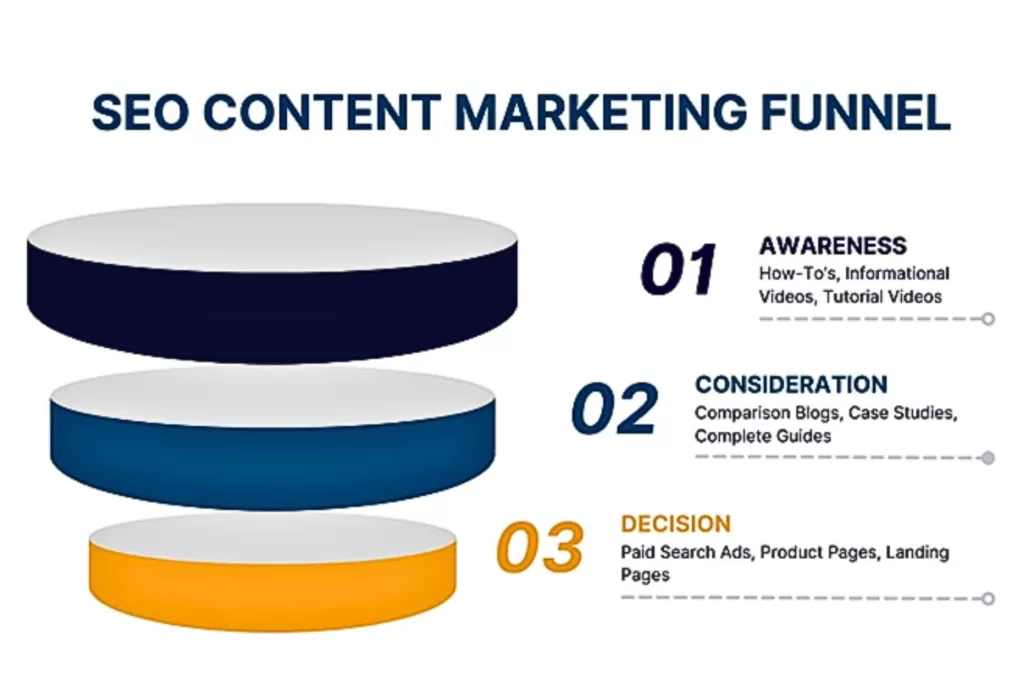
    Illustration of a SEO content marketing funnel

    Do you know the goals for the content you’re creating and who you’re trying to reach? If you don’t know the strategic importance of each piece of content you’re creating, it won’t be effective and can negatively impact its SEO performance.

    When you have a topic that you want to write about, ask yourself, “Who are the readers of this content?” If you don’t know the exact audience demographics, reference the content marketing funnel.

    By creating unique content for each funnel stage, you can meet your users where they are in their buyer’s journey. Some consumers may be ready to buy in the bottom funnel and want a straightforward answer before purchasing instead of reading an in-depth top-funnel blog.

    Others may be in the middle funnel stage and want an accurate comparison between two products that aren’t clearly biased to make a better purchase decision.

    Here’s where common SEO content categories fall in the marketing funnel:

    • Top-Funnel (Awareness): How-to’s, informational videos, etc.
    • Middle-Funnel (Consideration): Comparison blogs, complete guides, case studies, etc.
    • Bottom-Funnel (Decision): Paid search ads, product pages, landing pages, etc.

    When you understand your content goals and reader demographics for each piece, you can better solve their needs. It also sets you up for better success during keyword research, so you select the right search intent based on the funnel stage you’re writing in—which we’ll dive into more below.

    Choose Your Web Page’s Topic

    After determining your content goals, target audience, and funnel stage, brainstorm a general topic of what you want it to cover. This is the first step you’ll take when starting keyword research. You’ll end up finalizing the topic later once you have a target keyword.

    Conduct Keyword Research for Target and Secondary Keywords

    As mentioned above, your keyword research should do more than select the ones with the lowest keyword difficulty and highest search volume. While these attributes can find you great SEO opportunities, they shouldn’t be the only factors to consider if you want to target the best keywords in your content.

    Below is a step-by-step process for effective keyword research and avoiding common mistakes.

    Perform a Competitor SERP Analysis

    In the first step of your keyword research, search for your general topic on Google and review the top SERPs—those are your direct competitors for this content piece. Also known as a competitor SERP analysis, it provides insights that Google is showing you what qualifies as top-ranking content for that topic. It’s like finding out the secret SEO sauce.

    However, this doesn’t mean to copy what your competition is doing exactly. Google doesn’t reward duplicate content without added value, either.

    Analyze the attributes that contribute to their higher rankings and see what they all share in common, including:

    • Word count
    • Headings
    • Backlinks
    • Visuals

    Also, look for key details they might be missing where you can position your SEO content to outrank. Remember, Google prioritizes helpfulness and relevance. If you find that the competition is only providing surface-level details on the topic or lacks infographics to visually support the content, this can help your website rank higher in the SERPs.

    Run a Competitor Content Audit

    Image of a competitor SERP analysis between Nike and Adidas

    Next, take those top-ranking pages you found and do a content audit. Utilize SEO tools, like SEMRush and Ahrefs to analyze its performance. They have features like content gap and backlink analysis to see what’s contributing to its high SERP ranking with recommendations you can do to outrank.

    Check for the following during a competitor content audit:

    • Backlinks: Check which sites are linking to their page and their Domain Authority so you can try to earn a backlink from them, too.
    • Keywords: Look at the keywords they used and build a keyword list to optimize yours with it, too.
    • Performance: Analyze the content’s performance metrics, including traffic and engagement (clicks, comments, shares) to measure the topic’s success.

    With this approach, you’ll be able to streamline your keyword research process next.

    Conduct Keyword Research
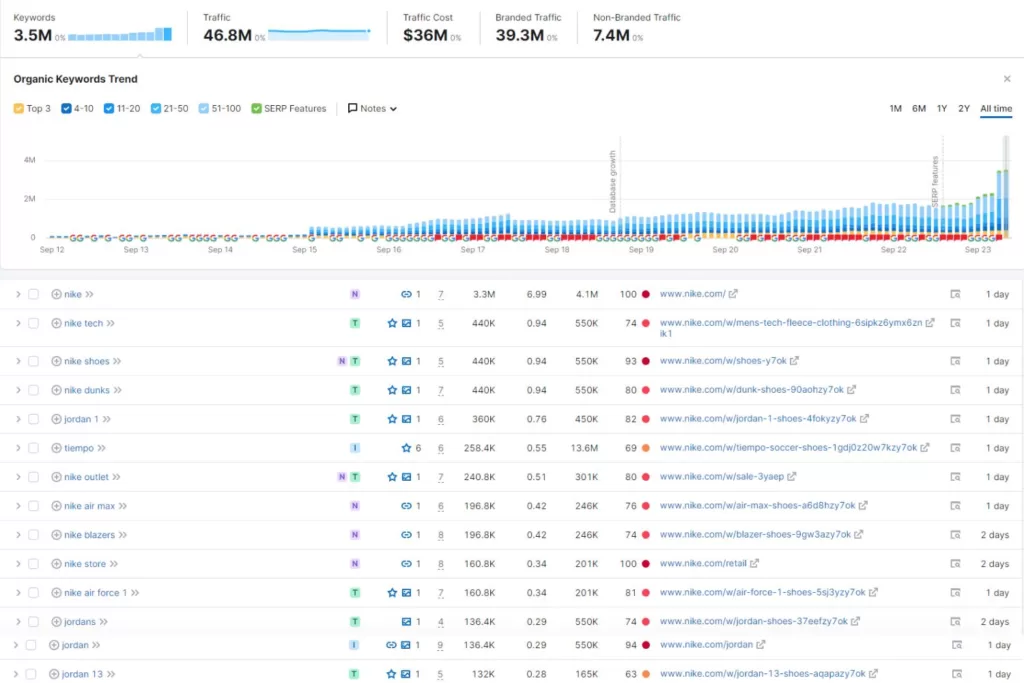
    Image of Keyword Research via SEMrush

    After a competitor SERP analysis and content audit, you now have a base list of target keywords. Don’t just copy the competition’s keyword lists. One of the most common mistakes brands make with keyword research is wrong search intent—the general reason behind a user’s search query.

    While some content has mixed search intent, it’s not always the best-case scenario. For example, if you optimize a top-funnel (informational) blog with bottom-funnel (transactional) keywords, it can turn users away because it’s not relevant to what they’re searching for. They’re looking for helpful information, not product pages or shopping ads.

    Remember, Google doesn’t reward irrelevancy if you use the wrong keyword search intent for your SEO content. Confirm the keywords are aligned with your content’s funnel stage by comparing the search intent.

    Search intent keyword examples include:

    • Informational (Top Funnel): how-to, what is, tips
    • Commercial (Middle Funnel): brand vs. brand, best recommendations
    • Navigational (Bottom Funnel): directions, branded keywords
    • Transactional (Bottom Funnel): for sale, buy, discount

    You can also automate this process with SEO platforms, which tell you a keyword’s search intent. This way you know which keywords to use based on the persona’s funnel stage you’re targeting.

    In addition to search intent and standard keyword metrics, like search volume and keyword difficulty, look for other types of keywords that can boost your content’s performance. Long-tail and question-based keywords are also effective keyword research strategies for SEO content writing.

    According to a study, 92% of search queries use long-tail keywords to find more specific results. Keywords with low search volume and keyword difficulty can also be great low-hanging fruit opportunities to boost organic traffic in your website’s content—so don’t rule those out!

    From there, you can build your finalized keyword list to select your focus and secondary keywords to optimize your content.

    Update Your Content Outline

    Now that you have your target and secondary keywords set, go back to your outline to update your content structure:

    • Create a title with your target keyword and search intent in mind
    • Write headings with focus and secondary keywords naturally
    • Add external and internal links you want to include

    This outline will be the foundation you’ll need to finally start writing website content.

    Write E-E-A-T Content With Your Audience in Mind

    With the preliminary steps complete, you can now begin your SEO content writing process. If you don’t know how to write content for a website, reference Google’s E-E-A-T framework. It’s their content model that can help you create helpful and relevant information that their algorithms prioritize.

    E-E-A-T stands for Expertise, Experience, Authoritativeness, and Trustworthiness. It’s designed to provide users with a higher standard of content and a better search experience when looking for information online.

    SEO Content Writing Mistakes to Avoid

    Many businesses always reference “high-quality content,” but do you know what that entails?

    Examples of low-quality E-E-A-T content include:

    • Copying competitor content without added value
    • Long paragraphs with more than 5+ rows
    • Using too many internal links
    • Disorganized heading structure
    • Bullet point lists with no transition text in between

    All the efforts you put into writing content for your website can harm its SEO performance if you’re making these mistakes when creating it.

    How to Write Content for Your Website Effectively
    With an understanding of SEO writing mistakes to avoid, here are the best practices you should follow.
    Examples of high-quality E-E-A-T content include:
    ● Easy Readability: Small paragraphs and bullet point lists to share information in a visually digestible way.
    ● Organized Headings: Users should be able to quickly scroll through your web page and know what it’s about.
    ● Supportive Visuals: Aim for helpful infographics or use stock images relevant to your topic.
    ● Compelling Storytelling: Grab users’ attention with a hook statement in the introduction, a persuasive CTA in the conclusion, and smooth flows in between.
    You want to keep your readers engaged, so don’t make it harder for them to understand your content when it’s the solution they’re searching for.

    Optimize Your SEO Website Content for Google
    Illustration of hands waving a wand to showcase the magic of ranking on Google

    Once your content is complete, you must optimize it with on-page, off-page, and technical SEO. Optimization ensures search engines discover your content and provide it to users when using related search queries to your topic.

    Optimize for On-Page SEO

    On-page SEO is straightforward. It means optimizing the content on the physical page itself and involves a few different steps.

    Keyword Optimization

    Optimize your content with your target and secondary keywords naturally throughout the text. The amount of keywords you use should balance with your word count. Also known as keyword density, this prevents you from over-optimizing your content. As a rule of thumb, add one to two keywords for every 100 words.

    Also, aim to have your target keyword as close to the introduction as possible naturally. It’ll help Google and your audience know what your content is about instantly.

    In addition to your content, optimize your keywords in your metadata. This is the language that Google uses to better understand your content.

    Best keyword optimization practices for metadata should include:

    • Title Tag: Keep within 60 characters to prevent it from being cut off in preview texts. Use your focus keyword.
    • Meta Description: Keep between 50 to 160 characters and use engaging language that persuades users to click through, like CTAs or a short summary of the solutions they’re seeking. Use your focus keyword.
    • Image Alt Tag: Keep it around 140 characters and use descriptive language so it’s accessible for all users online to understand. Look at the image and close your eyes to better describe it. Use your focus and secondary keywords when possible.
    • URL Slug: Keep between three and 250 characters, and don’t use special characters other than dashes. Use your focus keyword.

    Keep all metadata sounding as natural as possible so it doesn’t sound forced by keyword stuffing.

    Link Optimization

    Like keyword density, your link optimization should also consider your word count. As best practice, aim to have five to six internal links per page to prevent overoptimization. Internal links help keep users on your website by navigating them to other helpful information related to the topic.

    Add internal links to other blogs, case studies, and CTA in the conclusion—which is often a contact form, service page, or products. Use rich anchor text that’s relevant when hyperlinking to encourage users to click through so they know what the other page is about.

    For external links, one to three per page is a rule of thumb. Always use reputable resources with high Domain Authority (60 and above) so Google recognizes your content as an authoritative and trustworthy resource—aka, E-E-AT. You can also use external links that your competitors are using from your content audit when possible.

    Now you can finally publish your SEO content!

    Optimize for Off-Page SEO
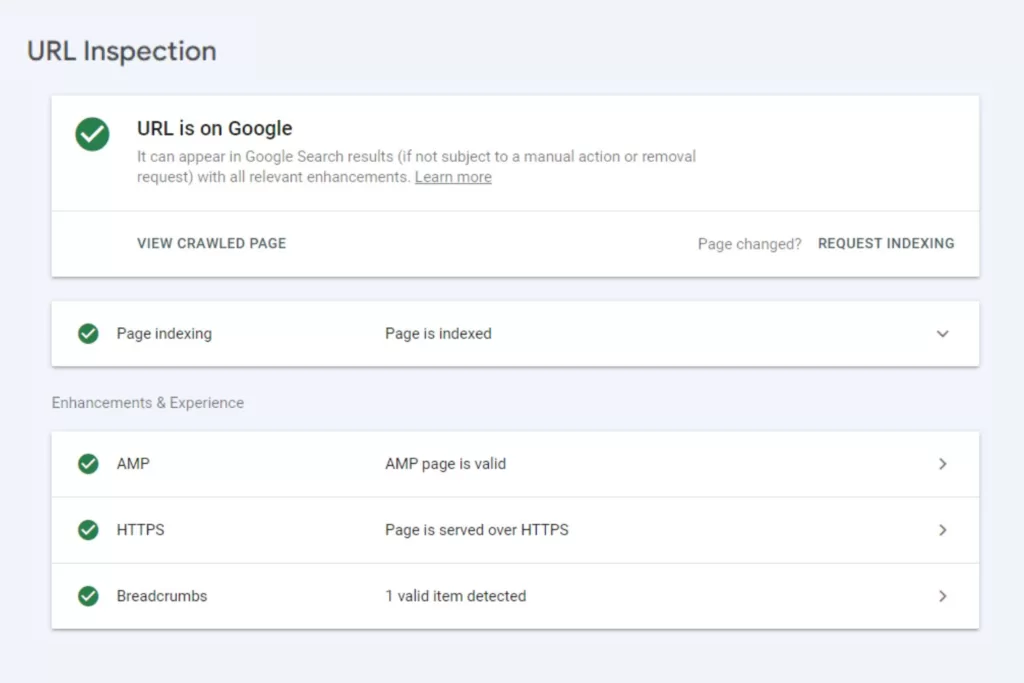
    Image of a URL inspection on Google Search Console

    Off-page SEO is the optimization that occurs off your website. Examples of off-page SEO include social media posts and link building. However, the first step after publishing your content is ensuring that Google and users can discover it.

    Request Indexing for Google

    Once your content is published, always request indexing on Google Search Console (GSC). If Google can’t crawl (find your content) and index it (store it in their database), neither will your audience. You can monitor the status in GSC to see if there are any issues that Google has with crawling or indexing it.

    Common indexing issues include broken links like 404 errors and duplicate content. GSC will provide reports so you know how to fix them, like replacing or removing broken links and editing duplicate content.

    Invest in Effective Link Building

    Link building is arguably one of the most important ranking factors on Google. When websites with high Domain Authority link to your site, it shows Google that you are an authoritative and trustworthy resource within your niche. In return, it generates referral traffic that has more qualified leads since a brand they trust is referring your company.

    Go above cold email outreach and utilize more effective link building strategies:

    • Social Media Posts: Offer cross-promotional social media shoutouts or include them in a campaign post.
    • Podcast Interviews: Find industry experts within your specific niche to form better relevancy for your target audience.
    • Broken Link Building: Contact websites you want to earn a backlink from by notifying them of broken links and offering to swap them with your site’s content.

    When you only cold email outreach, you’re essentially asking for a favor as a stranger. Provide something of value in exchange instead.

    Optimize for Technical SEO

    Technical SEO is what happens behind the scenes of your website. This type of optimization helps how your web pages are displayed and ensures they provide a strong user experience (UX). In addition to easy content readability, it should be simple to navigate too.

    Include the following in your technical SEO optimization:

    • Website Speed: Compress large image files or remove lengthy videos that aren’t adding value. Test the speed afterward on Google PageSpeed Insights for mobile and desktop.
    • Mobile Design: Test how your published content looks and performs on mobile to ensure it’s easy to read and navigate on all devices with breadcrumbs.
    • Website Analytics: Check if your site’s performance has a high bounce rate or low engagement. You can also review your top-performing pages and use those as a reference.

    Users nowadays will quickly leave for a competitor’s site if your site has poor UX, making technical SEO a crucial part of your content strategy.

    Reach Your Website Ranking Goals with Professional SEO Content Writing

    While anyone can technically write website content, that doesn’t always mean it’ll give you the results you’re looking for. At Reach Marketing Pro, our SEO services include professional SEO content writing and optimization. We also focus on your website’s functionality so your content provides a stronger user experience.

    Whether you need a persuasive product page or a compelling case study to showcase your successful track record, we can help you create high-quality SEO content your website needs to stand out.

    Our team will keep you informed throughout the content creation and optimization process with monthly performance reports to measure and track success.

    Ready to reach your SEO content writing goals?

    Contact us to get better website content that ranks today!
  • Search Generative Experience: How Google’s AI Search Engine Impacts SEO & Organic Traffic

    Search Generative Experience: How Google’s AI Search Engine Impacts SEO & Organic Traffic

    Search generative experience (SGE) is Google’s AI search engine. Chances are you may have interacted with it before. But do you know how this impacts your business’s SEO and organic traffic? Adapting your SEO marketing strategies to automated technologies is essential as they influence user online behavior and algorithms. 

    SGE Google has different features than its standard search engine. AI-generated results empower SERPs by using advanced systems to understand human language and legacy algorithms more clearly.

    However, it doesn’t replace traditional SEO. Google’s standard algorithms and SGE work together to deliver the best search results possible.

    Artificial intelligence is disrupting the digital market landscape and isn’t going away. That’s why your business must invest in SGE to meet your audience where they are when looking for information online. 

    Here’s a complete guide to search generative experience and how to optimize your SEO strategies with SGE to drive organic traffic.

    What is SGE?

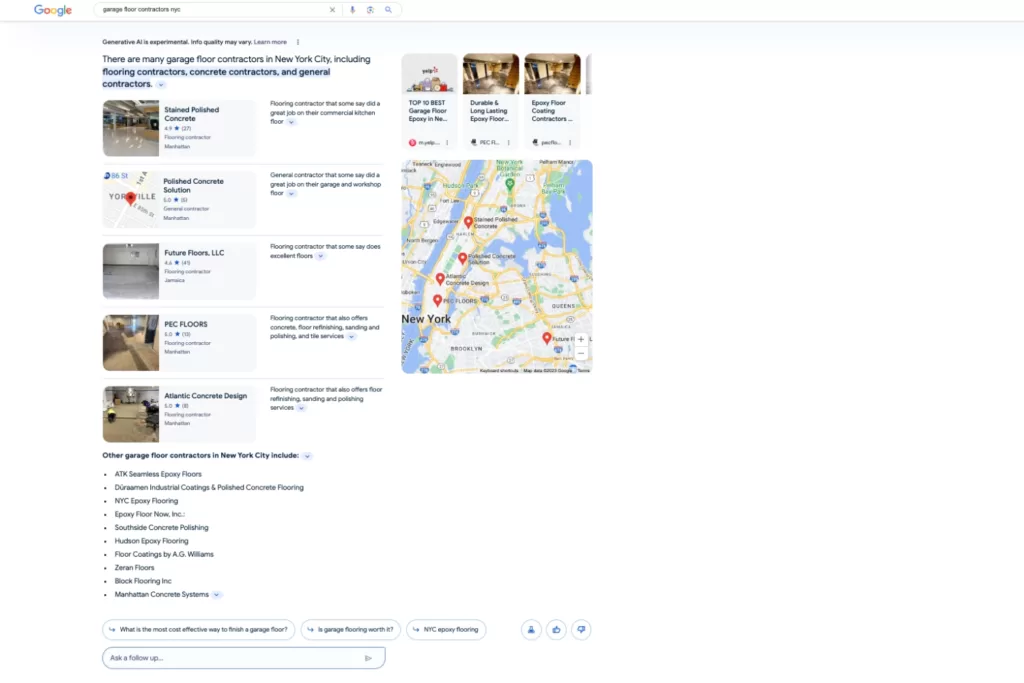
    Example image of a product search with SGE results

    People commonly ask, “What is Google SGE?” You may have heard of ChatGPT. SGE Google and ChatGPT are similar since they’re both AI learning tools that users can interact with conversationally for automated results. The difference is that ChatGPT is an AI-generated content-writing platform, and SGE is an AI-empowered search engine.

    SGE vs. SERP: What’s the Difference?

    Search generative experience and search engine results page (SERP) are both part of the search experience. SERPs are the pages Google displays in response to a user’s queries on a traditional search engine. SGE is Google’s AI search engine. It’s more experimental by using automated learning models and algorithms to deliver more relevant results.

    For example, SGE offers a more tailored experience for ad space. If you’re shopping online, SERPs often display rich results like product ad listings and reviews. SGE takes it further by showing you the same results, yet with more information. It includes follow-up questions, important product considerations, ad links, styling options, and more, all in one place.

    SGE allows users to dive deeper into their online shopping experience. It displays snapshots of everything they need to know about a product in one location—instead of entering multiple search queries and clicking on multiple sites to learn more.

    Google Search Generative Experience Features

    Image of Generative AI search results

    Now that you have a general overview of SGE Google, next is understanding its unique features. With many advanced capabilities, it can improve your SEO performance and the bottom line. Here’s how:

    AI-Powered Snapshots

    AI-generated overviews of topics you’re searching to provide helpful information quickly. It gives you access to more diverse content like retailers, publishers, and businesses.

    Follow-Ups

    Users can ask follow-up questions in a conversational tone to gain context and refine their search results more easily. This feature allows you to explore deeper into the topics you’re interested in with related insights and web page descriptions to learn more.

    Product and Local SEO Experience

    Snapshot overviews of products and Google Business Profile listings. E-commerce and local businesses can benefit from this feature by leveraging AI to create demand. It displays reviews, customer ratings, related information, and product images to influence faster purchase decisions in one centralized location.

    Search Ads Experience

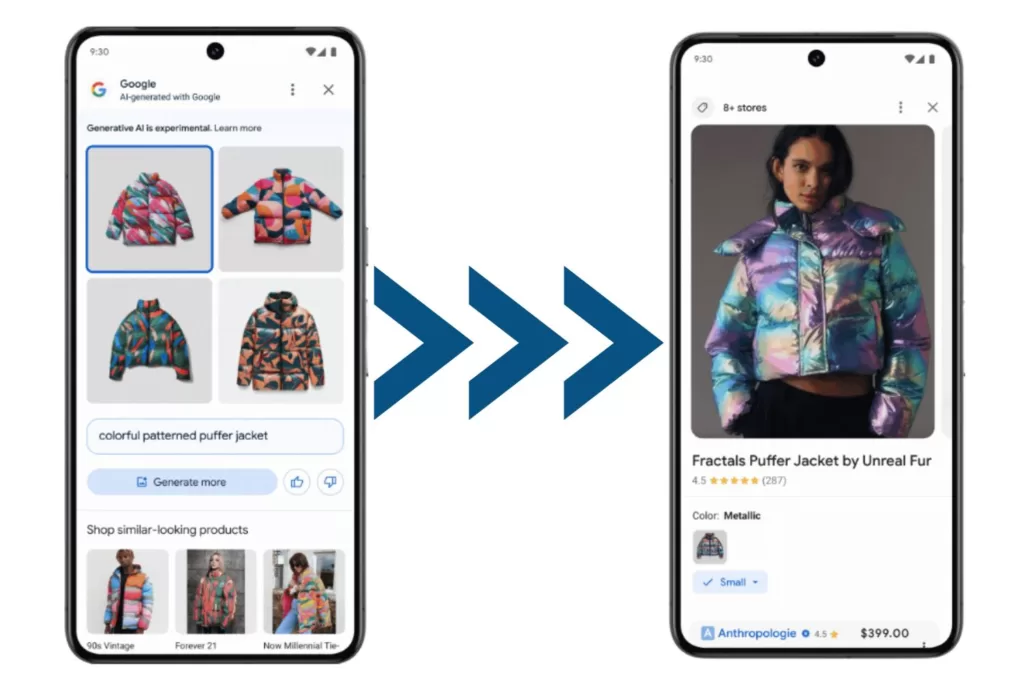
    These are dedicated ad slots to provide more helpful information while promoting your business online. Users can also use product images they find on social media, blogs, and more to locate where they can buy them online. It directs consumers to product pages and shopping ads based on the image screenshot they enter.

    This provides a seamless search ad experience when they don’t need to go on a hunt on where to buy items they’re interested in if they only have photos available.

    Image Generation

    AI-generated images help streamline visual marketing concept ideas and creative inspiration for your business. It’s like your automated graphic designer that creates any image you describe.

    E-commerce brands can benefit greatly from this feature since customers can generate images of the ideal products they want and be navigated to the real versions of them. SGE Google links to related shopping ads or product pages based on the generative image search information consumers enter.

    Image of ECommerce website on a mobile phone

    Common Concerns Businesses Have About Search Generative Experience

    If SGE Google delivers a more tailored and automated search experience, why would users continue using traditional search engines? Business owners often think that SGE SEO will replace standard SEO. Here’s why that’s not the case and why you should integrate search generative experience into your SEO strategies instead.

    SGE Concern: Taking Organic Traffic Away Your Website

    Businesses commonly think that AI will replace digital marketing, especially now with SGE SEO. It’s understandable to fear that SGE will take away your organic traffic since users no longer need to visit websites for information when everything they need is in one place—making traditional SEO obsolete.

    SGE Google cannot exist without humans. That’s why optimizing your site for SGE SEO is a necessary addition, not a replacement.

    SGE Solution: Writing Quality Content for Google AI Search

    Google search generative experience relies on human-written content to provide results. It takes your online information and displays it together while linking to the original content it generated from. SGE relies on people for it to exist. So, if your business stops creating content, it won’t have information to pull from.

    Writing content for SGE Google makes it a helpful feature for business growth because it supercharges SEO.

    Search generative experience only works because people enable it to!

    How SGE Google Impacts SEO and Organic Traffic

    While SGE doesn’t replace SEO, it does impact it. According to a study, 62.8% of SGE packs didn’t exactly match the content or keyword ranking of traditional local packs—including branded and nonbranded keywords.

    There’s no standardization across SGE and SERPs. For this reason, local businesses should reconsider their keyword research and local SEO strategies for SGE separately. SGE packs don’t always match local packs, even if the search intent is obvious.

    That’s why researching the SERPs and auditing SGE engines for target keywords is necessary for your SEO marketing strategy. If your business doesn’t adapt to AI generative search, you can miss ranking for local search queries that users are looking for.

    In addition to local SEO, here’s how search generative experience impacts SEO and organic traffic in general.

    Improves Organic Traffic Predictions

    SGE Google is also a helpful analytics tool to measure your website’s SEO performance. Its impact analysis model provides organic traffic predictions by comparing them to your current traffic data. This framework predicts which keywords are most likely to increase and decrease your site’s traffic, including how much.

    Strengthens SEO Performance

    When you can analyze which keywords may be responsible for decreasing your website’s organic traffic, you can better optimize it before it’s impacted. By mitigating SGE risks that predict which keywords may be attributed to your organic traffic, you can strengthen your site’s SEO performance from an unexpected drop.

    Identifies Strategic Keywords

    Identifying the keywords impacting Google SGE’s organic traffic predictions the most can help your business rank better in SGE. Target keywords valuable to your business may not rank in SGE snapshot carousels as they might do in the top traditional SERPs. Keyword performance for SGE and SERPs may have different ranks.

    With the SGE impact model, you can know which keywords you can’t afford to lose and which ones may be negatively impacting your SEO performance. By finding keywords contributing the most to organic traffic, you can strategically select better ones to optimize.

    Streamlines SEO Efforts

    When users can ask complex and descriptive questions more easily, they can understand topics or shop faster. Taking SGE’s suggested next steps or asking follow-up questions streamlines your SEO efforts because it’s less manual work for consumers to find relevant content. They’ll have all the information about your site in snapshot overviews to learn more.

    How to Optimize Your Website for SGE Google

    Image of Google Settings for SGE

    The first step to optimizing your website for SGE SEO is knowing how to get Google AI search first. Below is a step-by-step guide on how to access, download, and enable Google search generative experience.

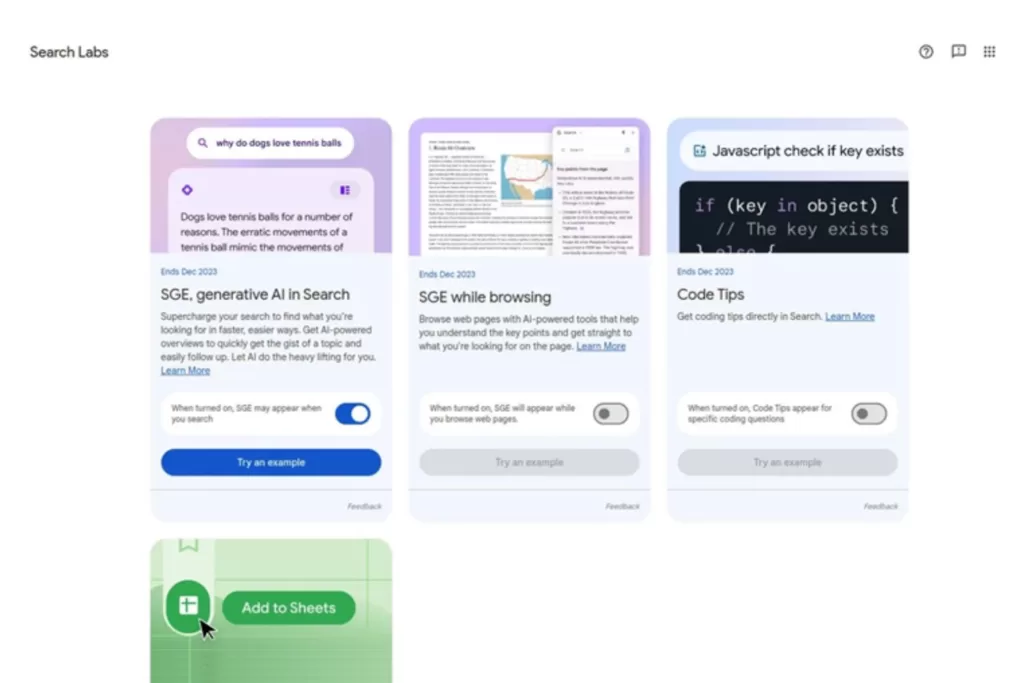
    1. Go to Google Seach Labs and join the waitlist to get access to limited-time experiments as an early tester. These features include “Add to Sheets,” where you can insert search results directly into spreadsheets, and Code Tips to automate programming language writing.
    2. Google will send you an email when you’re off the waitlist.
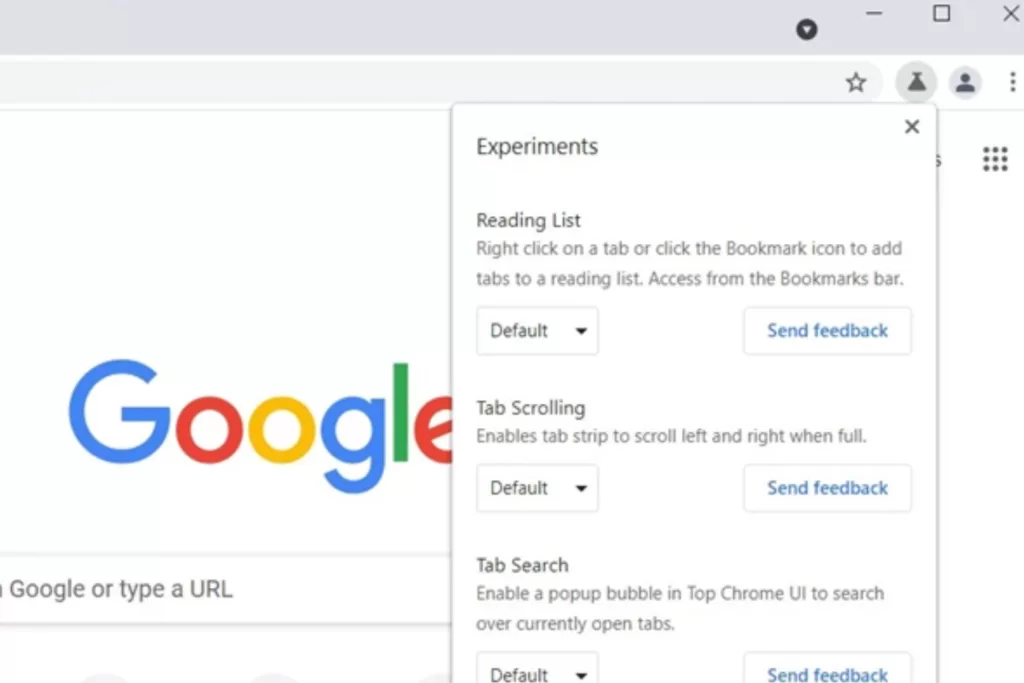
    3. Once you get Search Labs access, you can download Google AI search onto your Google Chrome browser with Incognito Mode turned off.
    4. Click the New Tab at the top of the browser.
    5. Click the Labs icon at the top right of the page.
    6. Turn the experiment on by clicking the slider on the top of the SGE card.

    You must sign up and in with a personal Google account as it’s currently not available to Google Workspace.

    Image of SGE Browsing Examples

    It may take time for SGE features to show up. Try doing some searches to see if it triggers AI-powered overviews—remember, these won’t always be available. Depending on your queries and the information available, SGE may or may not be triggered to deliver the best results possible.

    You can also check if your experiments are on by clicking “Ask a follow-up” under the “Overview” section. Google suggests asking questions about a topic with different angles to consider. They recommend finding a range of relevant information, options, or viewpoints.

    Once the experiments are available, you can begin optimizing your site for SGE Google. Here’s how:

    Create High-Quality E-E-A-T Content

    Did you know that Google recently added a second “E” to the now E-E-A-T framework? The second E stands for experience. This latest update shows that writing E-E-A-T content is essential since SGE is held to a higher standard for information quality.

    The original E-A-T standard was expertise, authoritativeness, and trustworthiness. It’s how Google evaluates if their search ranking systems are providing helpful and relevant information. With updated search rater guidelines, Google now prioritizes the importance of original and helpful content for users that can be explained in various formats and sources.

    Examples of low-quality E-E-A-T content include:

    • Web pages with misleading titles unrelated to the content
    • Pages that disguise ads as site navigation links
    • Copied or scraped content from other sites without adding original content or value
    • Keyword-stuffing content that doesn’t read naturally to people
    • Surface level details that force users to search more to find better information

    Here’s to write high-quality E-E-A-T content:

    • Create helpful content with your audience in mind. Provide insightful analysis with original information that’s relevant to the topic. 
    • Avoid copying and only rewriting content from external sources. Link to them, but add substantial value with a new perspective or educate further.
    • Write titles and headings as a descriptive summary of the page’s content. Users should be able to quickly scroll through your content structure and know what it’s about.
    • Make your content easily readable. Use small paragraphs of no more than four sentences with helpful visuals that support the content. Avoid fluff, irrelevant information, and unedited AI content writing.
    • Keep search intent in mind. Don’t spam users with sales promotions if you’re creating informational blog content on a specific subject.

    E-E-A-T content creation is about providing an overall great page experience. Google rewards websites that provide this because you’re creating people-first content while demonstrating that you’re a trustworthy authority and expert in your niche.

    Focus on the Most Important Keyword Rankings First

    Sitewide SGE audits and optimization can seem daunting. Start by identifying the most important keyword rankings you can’t afford to lose first. Then audit one page at a time for an organized process of SGE recovery.

    After conducting an SGE analysis, record your high-impact keywords, and optimize your existing pages with them. Then, rerun your SGE impact analysis to measure its new SGE SEO performance. Check if you’ve reduced the number of lost keyword predictions to ensure you’re on the right track.

    Invest in a Solid Link building Strategy

    Backlinks are arguably the most important ranking factor in SEO. Go above cold email link acquisition with solid linkbuilding strategies. Try offering social media shoutouts, podcast interviews, email newsletter blasts, and free link exchanges to offer a higher value in return.

    This helps show Google search generative experience that you’re creating high-quality E-E-A-T content.

    Review Your User Experience (UX)

    If users have difficulty navigating your website, SGE optimization won’t be impactful if they can’t find what they need. Signs of poor user experience (UX) include high bounce rates, slow page load speed, and complex mobile design. When performing SGE audits, review your UX to prevent pushing traffic away when users click through SGE into your site.

    Optimize Your Site’s Metadata

    SGE and SERP rely on metadata to better understand your site’s content because it’s written in search engine language. If Google can’t properly crawl your site through metadata, it won’t generate in SGE to consumers using relevant queries.

    Here’s how to optimize your site’s metadata:

    • Write valuable and enticing meta descriptions for each web page to engage users to click through, like hook statements and calls to action.
    • Include target keywords in your title tags, page content, and headings naturally, without over-optimizing. Don’t force keywords into your copy if it doesn’t sound right out loud.
    • Create image alt tag descriptions with target and secondary keywords for audience accessibility.

    Remember, if Google can’t find your site, your audience and SGE won’t either.

    Elevate Your Business’s Google Search Generative Experience

    Transforming your business’s online presence for SGE Google is a must with evolving AI technologies. At Reach Marketing Pro, we have extensive experience with SEO optimization, including on-page, off-page, technical, local, SEM, and SGE.

    We also focus on website functionality for a stronger user experience because SEO isn’t only about climbing Google’s ranks. Our team takes your site’s information and products to optimize it with your business’s SEO goals and branding in mind.

    While we do all the work, we keep you informed throughout the optimization process and provide monthly performance reports to measure and track success.

    Ready for your business to be an early adapter of AI search?

    Contact us to take the first step into your Google search generative experience today!

  • The Best E-Commerce Platforms to Build a Website

    The Best E-Commerce Platforms to Build a Website

    Have you ever been online shopping, and the payment process required you to create an account before purchasing? Or, have you ever compared two similar products, and the descriptions weren’t clear enough on the differences?

    Whether it’s a lack of guests and one-click checkouts to confusing product offerings, these are signs of poor user experience on an e-commerce website. This is one of many site design issues that can turn potential customers away and buy a similar product from your competitor.

    So, how do you know which e-commerce platform is best? Here’s how to pick the right one including, features, recommended website builders, and tips to consider before buying.

    What Makes a Good E-Commerce Platform?

    Illustration of multiple workers helping to build an efficient website mobile-UX

    Website development can be complex, especially if you don’t know how to build a website and what the process looks like. Even if you’re not tech-savvy, website builders are designed to be user-friendly for anyone to make one on their own.

    However, this is just a starting point. It’s up to you to customize your online store’s brand and ensure it pushes products at the forefront of what your target audience wants.

    Here are a few features to look for in an e-commerce platform and why they come in handy during the development process:

    Budget

    While budget may seem obvious, e-commerce platforms have varying prices and add-on costs depending on the package you purchase. Create a list of must-have and nice-to-have features for launch, and compare which builder can give you the best options based on your financial needs.

    Ongoing Website Support

    An e-commerce platform should have helpful support forums and an easy way to contact customer service for questions and challenges you may have during and after development.

    UX/UI Design

    As mentioned above, an e-commerce website with a strong user experience is foundational to the bottom line and can increase conversions by up to 400%. Can customers easily shop online through their smartphones? Or does it load products slowly and display them in a scattered design? If it’s difficult for you, pick another e-commerce platform that won’t push potential customers away.

    Analytics

    An e-commerce website’s performance analytics is fundamental to measuring success. Review the reporting and features the platform provides to ensure you can track key metrics and KPIs that are important to your online store.

    E-Commerce Website Features

    After preparing for development, understanding a site builder’s features must also be considered. From checkout customizations to drop shipping, these are some functionalities to look for as an e-commerce business.

    SEO

    If your online store isn’t optimized for search engines, it’s virtually invisible. That’s why it’s imperative to buy the best e-commerce platform with SEO features and functionalities. From metadata to custom URLs, investing in SEO is required for any website and business to succeed.

    Previous Experience with Website Builders

    If you have prior website development experience, check how easily an e-commerce platform can migrate from one site to another. Depending on your website size and complexity, some builders may charge a fee or not offer migration services at all.

    Keep E-Commerce Platform and Software Fees in Mind

    Illustration of two men trying to build an ecommerce website from scratch

    When searching for the best e-commerce platform, understand that software fees and different charging systems are involved. While it may seem tempting to pick the cheapest or free ones, these most likely won’t have the necessary features and integrations your online store needs.

    Remember, you get what you pay for. And as an e-commerce business, investing in your website is an extension of your brand’s success. Below are some common payment/fee structures for e-commerce website builders and how they work.

    Monthly Fees

    Depending on the website package you purchase, monthly fees will vary as each has specific offerings. The more inclusive the package service offerings are, the higher the monthly rates will be.

    Transaction Fees

    E-commerce platforms that process payments for you charge through a per-transaction fee, typically a percentage of each transaction. There are also payment processing plug-ins that may be more cost-effective than purchasing through a website builder.

    Payment Gateway Fees

    A fee system that charges for every online transaction the platform authorizes. Payment gateway fees are charged for every debit/credit card they authorize, while transaction fees charge for every completed purchase.

    5 E-Commerce Website Builders We Recommend

    Now that you know what to look for in a website builder, here are five of the best e-commerce platforms we recommend:

    1. Shopify

    Shopify is one of the most widely used e-commerce platforms available. If you have a large product inventory or an enterprise-size online store, Shopify allows you to manage up to 1,000 locations and has over 6,000 ready-to-install plug-ins. Even small businesses can benefit from this platform with streamlined fulfillment, shipping, and inventory management in one centralized place.  

    2. Squarespace

    Squarespace is one of the easiest platforms to work with. They offer plenty of user-friendly template design customizations and a large inventory management system. However, if scalability is a priority for your online store, other website builders may be more beneficial.

    3. BigCommerce

    BigCommerce is a high-performing e-commerce platform that’s built for retailers. Although it’s higher in cost, the returns you can receive are highly valuable. They don’t require additional platform fees like Shopify and offer built-in features to prevent pricing increases or add-ons.

    From seamless social media integration for multi-channel cross-selling to strong technical SEO features like automated redirects, this web builder is ideal for larger online stores and those with prior development experience. So if you’re selling small-scale, have a lower budget, and looking for a simple web build, this may not be the best option. 

    4. WooCommerce

    WooCommerce should be your go-to choice if your online store is built on WordPress. It’s a plug-in that integrates with WordPress easily for online shopping carts, abandon cart emails, customer rewards, and more. But, development is more complex compared to other platforms due to its highly customizable features.

    5. Wix

    Wix is the cheapest e-commerce platform option with monthly plans starting as low as $27 per month. With over 250 free applications and social media channel integration, this is the ideal beginner website builder if you want basic features.

    We Can Build Your E-Commerce Website for You!

    As a business owner, a new website is an exciting time. But, we understand you may not have the time to build one. You have to focus on your trade and managing the company.

    At Reach Marketing Pro, we have extensive experience with building e-commerce and non-e-commerce websites. Our web design and development services can create your online store while showcasing your unique brand. We ensure not only the best marketing strategies (SEO, SEM, Social Media) but also the website’s functionality to make a lasting impression on users.

    We’ll take all your company information and products to create a website with your business and audience in mind. While we do all of the work, we’ll keep you informed throughout the development process.

    Ready to kick off your new e-commerce website journey?

    Contact us to take the first step today!

  • How to Build a Website for Your Small Business

    How to Build a Website for Your Small Business

    Don’t get overwhelmed by the details. For small business owners, it’s common to not know how to create a website. You have to focus on managing the company and providing expertise in your trade.

    However, there are steps to prepare for the best web development experience and results possible— and it’s easier than you might think.

    A new web build is an exciting journey and can provide marketing opportunities, especially for small business owners. It’s an extension of your brand, mission, and products/services, which is crucial in an evolving and competitive digital marketplace. Consumers today expect a solid first impression before buying, and your website might be their first experience with your brand.

    Whether you’re utilizing a web designer and want to educate yourself or considering DIY, here’s a complete guide to small business website development in just 11 steps.

    Must-Have Details to Gather Before Your Website Build

    Before building a website, it’s practical to gather business details first to determine the type of site you need. For example, small e-commerce brands can benefit from creating a Shopify website. Shopify’s features include mobile-friendly product page design templates and payment gateways that are designed for e-commerce businesses. Company details, such as how many products or services you offer, also determine the website size you need.

    Here’s a pre-website build checklist to help guide you before development:

    • Web Hosting: Pick a domain name (website name/address) and register it with a web hosting provider.
    • Web Designer: Who is responsible for the web build and design?
    • Website CMS: Which CMS (content management system) platform will you use? Ex: Shopify, WordPress, HubSpot, etc.
    • Company Brand: What are your branding guidelines? Gather your brand colors, fonts, logo files, visual do’s/don’ts, content rules, and reference sites for design inspiration.
    • Website Trends: Research current web design trends to ensure your site meets new consumer demands and search engine algorithm updates.
    • Site Maintenance: How committed are you to maintaining and updating your website as needed? Who is responsible for this?
    • Web Content: Do you have current marketing collateral? Are you committed to creating unique content for your website?
    • Website SEO: Do you know how to properly optimize your website for search engines and keep up with competitor SEO rankings?
    • Website UX (User Experience): Can users quickly navigate your website and not feel overly spammed?

    While this may seem like a long or detailed checklist, it’s worth it. The more you prepare before a website build, the better the process is. Simply gather this information into designated folders and your web developer will have everything they need. It also eliminates the need for further back-and-forth on missed items.

    How to Build a Website for Your Small Business in 11 Steps

    Illustration of people designing a website with color switches, a desktop PC and a pencil

    Now that you know the information needed before a web build, we’ll explain how exactly a website is created. From design inspiration references to domain name registration, here’s how to build a website for your small business in 11 steps.

    1. Identify Your Target Audience to Understand Your Traffic Sources

    Do you know who your ideal customer is? Understanding your target audience is crucial to web builds because it should be designed with them in mind.

    Dive deeper into your buyer personas. Address their common questions and challenges so you can provide related and specific solutions through your website. This way, you can drive potential traffic with more qualified leads since you understand what influences their online behavior.

    Define your business goals for your website. Whether it’s selling products or offering services, identifying your target audience is the foundation of creating a successful website. It determines how you’ll connect and persuade them to engage with your site.

    2. Research Competitor Sites for Design Inspo and Marketing Opportunities

    Certainly, don’t copy what your competitors are doing with their websites. Avoid using the same color scheme, exact layout, and images. However, it’s beneficial to have visual inspirations for how you want your website to look. This way your developer understands the creative design and structural direction you’d like to incorporate.

    Researching your competition is also an effective marketing strategy to uncover missed opportunities in their web design. For example, if you’re a boutique e-commerce brand and discover that your competitors don’t utilize one-click checkouts, this can be a great opportunity to provide a better online shopping experience.

    One-click checkouts can increase transactions by 25.8% since customers aren’t burdened to create an account before buying— resulting in reduced abandoned carts and checkouts. Finding ways to make your website look and perform better is key to outdoing the competition and prioritizing your products or services.

    3. Select a Domain Name that Represents Your Brand

    A domain name is more the name of your website address. It represents your brand and determines how users feel about your business based on a name alone. Domain names also cannot be changed or modified once you register them. For these reasons, it’s critical to select a domain name that accurately represents your company’s identity, mission, and values.

    Consider the following when picking a brandable domain name:

    • Make it simple, short, and impactful: Make a memorable and brandable domain name under 15 characters.
    • Aim for a “.com” TLD when possible: Top-level domains (TLDs), like “.shop” for e-commerce brands or “.org” for non-profits, can be suitable options if “.com” is taken.
    • Avoid long or hard-to-pronounce words: Prevent users from misspelling your website or making it harder to find.
    • Don’t include slang, numbers, or hyphens: Focus on a seamless user experience so consumers can access your site easily.

    If you need inspiration, there are domain name generators, like Shopify and Wix, where all you need to do is enter a keyword, and creative options are prompted. However, you must ensure that a domain name hasn’t been taken by checking if it’s registered online.

    4. Register Your Domain Name with a Web Hosting Provider for Copyrights

    Now that you have a domain name in mind, the next step is registering it so you own the copyrights and trademarks. But before you do, confirm it’s available by checking its registration. A common source to verify if a domain is already registered is through domain name search tools like GoDaddy or ICANN.

    There are options if you want a domain name that’s registered:

    • Buy it from the owner: If the brand is inactive, has a dated website, and has no social media presence, there’s a chance the owner might accept an offer.
    • Use different TLDs: If “.com” is taken, try registering with “.shop,” “.co,” and other authoritative TLDs.
    • Consider name variations: Brainstorm other creative versions of the domain name you want. Make them specific to your niche to avoid duplication.

    Once you verify a domain name isn’t registered, it’s available for purchase. Popular website hosting platforms, such as BlueHost and Hostinger, offer tools that automatically register domain names for you.

    Domain HostingContent Hosting
    Website addressWebsite CMS (content management system)
    Domain names cannot be changedEdit content without markup or programming
    Hostinger, SiteGround, BlueHostWordPress, Drupal, PrestaShop

    Some hosting platforms, like GoDaddy and Squarespace, also provide CMS systems. It may be a beneficial option to consolidate your website marketing services, especially if you don’t know how to build a website. Ensure you compare all options that are best for your needs and budget.

    5. Choose Your Content Hosting Platform for Simple Content Management

    In addition to a domain hosting provider, you’ll also need a content hosting provider—also known as a CMS (content management system). The difference between domain vs. content hosting is their functionalities and customization.

    A domain hosting provider hosts your website on a server to function properly. While you can change hosting providers, domain names cannot be changed or modified once registered. 

    A content hosting provider stores your website’s content and shares its files, and hyperlinks pages. Its purpose is to give website owners easy access to edit their content without the need for marking up or programming languages.

    Each content hosting site has various capabilities, plugin updates on their platform, monthly/yearly fees, and more. So, when picking a content hosting site, consider the must-have functionalities that are key to your business, like simple SEO plug-in integration or user-friendly blog management.

    6. Create a Skeleton of Your Site for Streamlined Web Development

    Illustration of a phone and computer screen with different screens on it. Showing UX for different devices.

    A skeleton is a visual roadmap of what your website design will look like. The purpose of site skeletons is to streamline the development process so business owners can see how exactly their website will be laid out. It helps with revisions or new design changes before placing it on the content hosting platform.

    Here’s what you should consider when reviewing your site skeleton:

    • Do you have an eye-catching homepage that quickly explains what you do as a company?
    • Is your branding clear?
    • Are the products/services you provide easy to find, read, and clear?
    • How much content do you have that will be displayed throughout the site?
    • Do you have testimonials, FAQs, press releases, or blogs you want to feature?
    • How will a customer/client contact you?

    While website updates are doable after launch, having a preview design through skeletons can reduce the need for more revisions before content uploading.

    7. Optimize Your Website for Search Engines and Online Visibility

    After finalizing your small business web design, the next step is to ensure search engines can effectively find and store it through off-page, on-page, and technical SEO. If search engines like Google can’t discover (crawl) and store (index) your website in their database, it’s virtually invisible to users online.

    Some ways to optimize your web pages and drive traffic to your site include:

    • Use a mobile-first approach to your design and site responsiveness
    • Index all web pages in Google Search Console for indexing and crawling (off-page SEO)
    • Invest in technical SEO with fast loading times and site breadcrumbs for easy navigation
    • Implement on-page SEO by writing optimized page titles with target keywords

    In addition to visibility and traffic, website optimization is crucial to keep up with your competition. By maintaining best SEO practices, you can promote competitiveness by ranking for similar keywords while building your online presence.

    Business websites that rank at the top of their niche’s SERPs (search engine results page) generate a 39.8% CTR (click-through rate), while second ranks receive 18.7% and third at 10.2%. Optimizing your website isn’t only for search visibility and keyword rankings. It’s also an effective SEO strategy to increase engagement and leads.

    8. Create and Add Content to Your Website That Aligns with Your Brand

    Every website needs content. Whether you’re repurposing old marketing collateral or writing unique content, each web page needs written text and visuals. This includes home pages, product/service descriptions, graphics, page headers, and blogs. After creating and reviewing your content to ensure it aligns with your brand and business, place it throughout your website. Remember to optimize your content to ensure search engines and users can discover it.

    9. Review Your Website on Mobile and Desktop for a Better User Experience (UX)

    Illustration of a person sitting at a desk looking at a website with a car on it

    Check your website multiple times across several devices, including mobile and desktop. Review the site layout on your computer, phone, and tablet to ensure easy navigation and strong user experience (UX).

    UX is the user’s overall experience when interacting with a website or application. It plays a critical role in maintaining customer satisfaction and may push potential new ones away. If not, it’s considered in your site design.

    For example, conversion rates drop an average of 4.42% for each additional second of page load time. If your site has slow web response rates, low-quality images, or irrelevant content, these are signs of poor UX design. Websites with strong UX design can increase conversion rates up to 400% because they’re designed to be simple to navigate and easily accessible.

    Some ways to improve UX design for small business web development include:

    • Create Flowcharts: Use these visuals in your site’s skeleton to decide how users will interact with your site for the optimal experience.
    • Conduct Interface Tests: Gather data on the experience quality of your site and compare the effectiveness compared to other user interfaces.
    • Create User Surveys: After launch, chat with potential and existing users of your system to gain feedback for UX improvements.

    Before launch, get a close friend, colleague, or relative to view the staging link on their devices and provide feedback. Getting a fresh perspective can uncover UX design issues you may thought were working but are invisible to the user.

    10. Launch Your Website to Make it Live!

    Once everything is reviewed, added, and to your liking, click that “Publish” button! Congratulate yourself or your team for this major business accomplishment. After launch, it’s essential to monitor your new website to ensure it’s running smoothly.

    Here’s a post-website launch checklist to help guide you:

    • Submit your site to Google Search Console for indexing and crawling
    • Monitor your site in Google Search Console for any design errors, like duplicate pages or broken links
    • Setup Google Analytics with your site to monitor its performance and gain valuable data
    • Spread the word on social media as part of your off-page SEO strategy

    Regular updates are an ongoing process after you build a website for your business. From content marketing to structural improvements for UX, a site launch isn’t the end of the process but the beginning of a new chapter.

    11. Plan for Regular Website Maintenance After Launch

    All websites will have regular maintenance, including plug-ins, platform updates, backups, product/service changes, etc. However, if a consumer finds a business with a website that seems outdated, has broken links, or slow loading, they’ll most likely move on to another competitor. Keeping your website regularly maintained is easier than a complete revamp.

    Let Website & SEO Experts Handle Your Website Build for You

    With these steps, you can streamline your small business web design. But as a business owner, we understand if you don’t know how to build a website— and you shouldn’t have to.

    Professional web developers have expertise in custom mobile-responsive design and plugin integration that you can’t do on your own or as easily. They can create unique site features to make your brand stand out and ensure its structure meets search performance requirements.

    At Reach Marketing Pro, we’re a full-service digital marketing agency and can guide you every step of the way. From website design concepts, content creation, monthly site updates, and SEO optimization, we help ensure our clients are successful in providing the best user experience for potential and returning customers.

    Skip the hassle of creating a website and let our SEO and web development team do it for you. Our developers provide superior design, webmaster services, and site management to handle all of your website’s needs. This way you can focus on what you do best, your trade.

    Contact us to kick off your new website journey today!

  • How to Block a Website on Different Devices and Browsers

    How to Block a Website on Different Devices and Browsers

    Why Would You Need to Block a Website?

    There are many reasons why you would want or need to block a website. For example;

    Parental Controls: If you have children, some websites contain explicit content that you want to keep them from.

    Increase Productivity: Permanently or temporarily block certain websites to improve your productivity time for studying or working.

    Suspicious Sites: Save yourself from attempts at infecting your computer with a virus or stealing your personal data.

    Which Site-Blocking Method is Right For You?

    Each method of site blocking will vary based on its restriction, the users, and the device you’re using. For example, if you want to block websites temporarily or permanently on an individual device, it’s recommended to install a more configurable program or easy-to-use browser extension.

    If you want to block manually through the host’s file, firewall, or router, it’s a good option if you don’t want to deal with software. However, this method is only suitable if you want to disable access to certain sites permanently.

    If you’re blocking certain sites for multiple users on a single network, you should use either web filtering software, which is normally used by businesses or schools, or block through the router.

    How to Block Websites on Your Browser

    Illustration of the Chrome, Safari, Firefox, and Internet Explorer Web Browser Logos

    Chrome

    1. Log in to your Google Admin Account and go to the Chrome browser homepage.
    2. Click Devices Chrome Settings Users & Browsers.
    3. Choose which users you want to block from visiting certain websites.
    4. Find the URL Blocking section.
    5. Enter the web address you want to block in the Blocked URLs tab.
    6. Save the changes.

    Firefox

    1. In the Options page, select the Privacy & Security tab.
    2.  Scroll down to the Permissions section and click the Block Websites option.
    3. In the Block Websites page, enter the URL of the website that you want to block, and then click the Add button.

    Safari

    1. Go into the Content and Privacy section of Screen Time.
    2. Click Customize to block specific websites. 
    3. Click the “+ under the restricted section to block specific sites.
    4. Add the URL of the site you want to block and click OK.
    5. Select OK again to finalize your decision to block a site.

    Internet Explorer

    1. Open the browser and go to Tools (alt+x) > Internet Options.
    2. Click the Security tab.
    3. Click the red Restricted Sites icon.
    4. Click the Sites button below the icon.
    5. Now in the pop-up, manually type the websites you want to block one by one.
    6. Click Add after typing the name of each site.
    7. When done, click Close and click OK in all other windows.

    Blocking Websites on Your Mobile Device

    When using an Android and or iOS device, you will need to download specific apps to block unwanted websites. Thankfully, most apps can work across multiple browsers! Here are a few examples of apps and their features:

    BlockSite

    StayFocusd

    Parental Controls

    FamiSafe

    AdBlock

    Manually Block Websites on Your Desktop or Laptop

    Illustration of parents and their child in front of a blocked computer screen

    Looking to block a website manually? Here are step-by-step processes for how to block a website on Windows 10, Mac, or with your router.

    Windows 10

    1. Go to the Chrome Web Store
    2. Search for the BlockSite extension, and choose the first one that reads: BlockSite: Block Websites and Stay Focused.
    3. Click Add to Chrome.
    4. Click Add Extension on the prompt window.
    5. Go to the website you would like to block on Chrome and right-click anywhere on the page. Tap on BlockSit” then Block this Site.

    Mac

    1. Click on the Apple icon locked in the top-left corner of the screen and select System Preferences.
    2. Choose Screen Time.
    3. Click Content and Privacy in the left sidebar.
    4. Click Turn On, located in the top-right corner of the window, unless already enabled.
    5. Choose Limit Adult Websites and click Customize.
    6. In the Restricted section, click the plus symbol.
    7. Add the desired URL and click OK.

    Router

    1. Open your web browser and type in the IP address of your router.
    2. Log in to your router’s settings.
    3. Find the website blocking tool in your router’s settings.
    4. Enter the websites that you want to block.
    5. Save your changes and restart your router.

    Parental Controls on Windows 10

    1. Visit family.microsoft.com and log into your Family Safety account.
    2. Choose your family member then scroll down to Content Filters.
    3. Toggle on Filter Inappropriate Websites.
    4. To block specific sites, add their URLs under Blocked Sites.
    5. You can block access to specific sites by turning on the Only use-allowed websites toggle. 
    6. Add URLs of approved websites under Allowed sites.

    Parental Controls on a Mac:

    1. Click the Apple icon and select System Preferences.
    2. Click the Parental Controls icon.
    3. Click the lock symbol and enter your password.
    4. Select the account you want to filter with parental controls.
    5. Click Enable Parental Controls.

    Additional Methods to Block a Website

    Illustration of an increasing graph and gears representing improved productivity

    In addition to the above, there are additional ways to block unwanted websites. Here are some ways to do that.

    Using Browser Extensions: Using specific extensions on your browser helps block certain websites you don’t want other users to visit. For example, BlockSite is a Chrome Extension that helps block web pages and limit adult websites individually or by categories.

    Using Productivity Software: Using these samples will help reclaim your productivity and steer away from potentially dangerous websites; Freedom, Forest, PawBlock, RescueTime, Pause, Focus, etc.

    Leverage Web Filtering Software: These help block unfiltered websites from being accessible on your computer. Examples include WatchGuard.

    Let Our Team Help You Gain Productivity Time

    When working with Reach Marketing Pro, you’ll know your privacy and security always come first. We have the skills you need to strategize, analyze, and curate creative designs for your business, giving you back time to focus on what’s most important!

    Reach out to us today to receive a FREE marketing consultation.

  • How Search Marketers are Using AI to Create Demand

    How Search Marketers are Using AI to Create Demand

    How Do AI-Powered Search Engines Operate?

    Illustration of a robot holding a magnifying glass over a business laptop

    For anyone looking to dive into digital marketing, search engine algorithms aren’t a new concept to learn. An AI search engine collects insights from multiple sources such as search queries, browsing behaviors, social media interactions, and purchase histories. They utilize sophisticated algorithms to analyze any collected data, identify patterns, and generate actionable insights. However, AI marketing has changed more than one may think! Since it’s recognized for making things easier, it helps alleviate the typical effort of interpreting customer preferences from large data sets and provides information that’s reliable. By utilizing it correctly, AI search engine marketing can develop and implement targeted marketing campaigns, optimize customer journeys, and deliver personalized experiences.

    Search Marketer’s Use of AI

    What marketers need to focus on when using AI-powered tools is providing high-quality, user-centric content that appeals to the interests of their target customer base. Additionally, optimizing a company’s user experience can enhance the overall experience for consumer audiences. AI search considers a user’s previous search history, location, and additional factors to provide personalized results, producing a more efficient zero-click search experience.

    Capitalizing on AI-powered search will create content that clearly answers questions, provides efficient solutions to complex problems, and delivers a positive user experience.

    How AI can Help Search Marketers

    Illustration of a man working on his computer getting the help of AI

    AI is different for each business and that should remain top of mind when creating an efficient, customized strategy. Here’s how AI-powered tools can help create a more efficient digital strategy and how they can aid Search Marketers in improving their campaigns:

    Creative Testing: This strategy helps creative teams revise concepts, drop ones that don’t resonate well with target audiences, and identify which ones work the best. This testing can be used to conduct market research before a new product launch.

    Campaign Optimization: This strategy helps boost a company’s visibility and conversation rates, which drives more potential customers in their direction.

    Measurement: Analyzing measurements serve as quantifiable insights to search marketers. When using them correctly, measurements can project the success of an advertising campaign and track toward KPIs.

    Improve Productivity: Productivity is important in AI marketing because it serves as a key contributor to driving unparalleled growth and profitability.

    Reiterating what was mentioned above, AI-powered tools are indeed tools and should be placed in a proper strategy instead of simply taking information and mixing them together.

    AI Search Engines, Search Marketers, and You

    Image of a group of people working and using AI for business results/analysis

    AI marketing takes digital strategy to the next level. Using a personalized marketing strategy with search marketers can help them leverage their expertise in AI-powered search engines may help their marketing initiative. Let’s break it down further.

    Tailored Marketing Strategies: These help a business identify its unique selling proposition, target its right audience, and create compelling narratives that resonate with its ideal customer.

    Having a Competitive Edge: Having a competitive advantage helps a business effectively distinguish itself from its competitors by offering something unique of superior value to its customers.

    Measurements: There are multiple ways a business can measure its performance, including tracking processes, sharing intelligence, making informed decisions, identifying goals, developing reliable metrics, and collecting valuable data that accelerates growth and development.

    Enhanced Customer Engagement: Implementing a customer engagement strategy will not only help improve the overall customer experience, but boost the value of a business’s existing relationships, increase the likelihood of referrals, and foster sustainable growth.

    Our Experts Use the Right Tools & Expertise!

    Although AI marketing carries a unique mind of its own, utilizing SEO and SEM specialists help leverage their knowledge and expertise to keep up with evolving technology to implement a personalized marketing strategy. At Reach Marketing Pro, we serve as your digital strategy partner to optimize business performance and uptick growth to ensure your company has a competitive edge in your industry.

    Are you ready to take the first step and evolve your marketing strategy using AI-powered tools?

    Contact us here to get your personalized AI marketing strategy started!

  • Website Domain vs. Content Hosting Explained

    Website Domain vs. Content Hosting Explained

    Domain vs Hosting:  What’s the Difference?

    To make it simple, the key difference between domain and hosting is that a domain is the website’s address, which allows visitors to easily find your website online. Hosting is where the website files and designs are stored. For example, GoDaddy is a hosting site, while www.reachmarketingpro.com is a domain.

    There’s also a term called content hosting, which is a service where your website’s content is managed with a CMS, or content management system. These systems enable website owners or marketing teams to edit the website’s content, share its files, and hyperlink pages without marking up or adding programming languages.

    Both are Needed for a Successful Website

    Illustration of a website screen with different content displayed

    Unfortunately, to have a website you can’t have one or the other. While you have the domain, your website must be hosted on a server to function properly. The goal is to have visitors see your site and hopefully make a purchase. You can purchase a domain name and not have a website. However, a website can’t be hosted without a domain name. So if you’re starting the journey to getting a website, start with choosing and purchasing a domain name.

    How to Choose the Right Domain Name & Content Hosting Platform

    Illustration of people around a computer choosing a domain name

    Looking to choose the right domain name? Here are some tips on how to find the perfect domain name and content hosting platform.

    For finding and purchasing a domain:

    • Naming tips: find a “future-proof” name that is short but memorable.
    • Prevent trademark infringement by researching domain names before making the purchase.
    • Look into potential costs, as each domain comes with a different price tag.
    • Lead negotiations after conducting your own research and landing the best price for the domain.

    For finding a web content hosting platform:

    • Based on the type of website you are looking to host, there are specific platforms that are best suited.
    • Look into the best search engine optimization (SEO) tips that will enhance your website’s visibility and google search rankings. This will also play a role in the marketing.
    • Each hosting platform comes with its own set of security protocols. Look into each platform and how they oversee the maintenance and upkeep of the website so you know how your website will be managed.
    • Each hosting platform comes with different maintenance packages based on specific customizations. Although cost plays a factor, research plays a role to see which package and hosting platform fits your needs best.

    Things to Consider Before You Select Your Web Hosting

    Illustration of a man sitting at a desk creating a website

    Here are some things to consider before selecting the platform to host your website. First off, there are multiple types of web hosting platforms, including WordPress, Drupal, Squarespace, and PrestaShop. If you already have an established domain and web-hosted website, it can be successfully transferred to another company if needed.

    However, there’s something you should know. An already registered domain name can’t be modified or changed, so it’s important to know a new one has to be purchased and implemented to the existing website, or a new one will need to be created and linked to the old one, essentially, redirecting from the previously created domain name to the new name so you don’t lose website traffic.

    Resources for You Consider

    There are valuable resources to utilize when purchasing a domain and choosing a content hosting platform. Here are some of our recommended domain and content management resources:

    For purchasing a domain: Hostinger GoDaddy, and Squarespace.

    For content hosting: WordPress, Drupal, Squarespace, and PrestaShop.

    Let Our Team Do the Work for You!

    Finding and creating domain names can be a tricky process when you endure it alone. Rather than trying to figure it out, rely on an expert who can guide you through the domain purchasing process, website development, and content creation for your new (or redesigned) website!

    At Reach Marketing Pro, we help you every step of the way, no matter if your business is new or well-established. Allow us to create a branded, optimized, and functional website for your business! If you have a question, ask us here!

  • Should You Have AI Write Content for You? The Pros & Cons Explained

    Should You Have AI Write Content for You? The Pros & Cons Explained

    What is Content-Writing AI?

    Artificial intelligence (AI) incorporates human intelligence to create content through computer software. These cutting-edge programs are modeled after original human thought processes to create unique content based on what you are looking for. When using AI, you surrender the opportunity of human error, such as typos and grammar mistakes. Since it is time-consuming to produce valuable and insightful blogs, articles, and essays, artificial intelligence technology steps in to play hardball. Curious about what professionals today use AI for? Normally, you will find landing pages, marketing copy, product descriptions, SEO-driven blog topics, evergreen content, and social media copy for starters.

    The Benefits of Using Content-Writing AI

    Illustration of a man standing in front of a desktop with a content-writing assistant

    Utilizing AI writing tools come with unique benefits. For instance, one major benefit that comes with AI content writing is the ability to save so much time. For example, rather than spending countless hours brainstorming, constructing outlines, and proofreading, AI writing tools serve as the second pair of eyes to ensure the content is correct while increasing your productivity to focus on other tasks. Additionally, artificial intelligence helps drive website traffic by crafting SEO-optimized, readable content.

    If you struggle to come up with new writing topics, AI tools step up to the plate and hit a home run with unique content suggestions, which help boost your creativity and improve your writing abilities. The number of opportunities is endless with AI writing tools!

    Disadvantages of Using Content-Writing AI

    Illustration of different content-writing topics and a magnifying glass

    With the benefits that AI writing tools provide, there is always a downside. For instance, cost. Based on if you are looking for short-form content or more full-scale projects such as a robust, research-driven article, premium software would be required. In that case, you should prepare to invest hundreds of dollars, if not more, monthly.

    Secondly, it’s best to understand that you can’t immediately depend on the AI to take over things without ample time to prepare. With every AI writing software comes a learning curve.

    Most importantly, using artificial intelligence removes each writer’s unique personality. Unfortunately, since AI writing tools are based on “human intelligence”, they will always have a more “robotic” personality in the content, which lacks emotional appeal. Additionally, with the more robotic personality, you may seem to notice an unnatural flow of content that has multiple paragraphs that is repetitive, but slightly reworded. That may lead to worrisome thoughts of possible plagiarism.

    Lastly, E-A-T concerns are a red flag when using AI writing tools. Without a personal touch or emotional appeal, Google’s algorithm may reduce your content’s visibility as far as it appears in Expertise, Authoritativeness, and Trustworthiness.

    How to Use Best Practices When Writing-Content with AI

    Illustration of robot's face in the center, surrounded by content-writing related icons

    Looking to utilize artificial intelligence in your content strategy? Here are some key tips and tools to keep in mind.

    • Your chosen AI writing tool should never be your sole outsourcing solution for your brand’s content. Instead, it should act more as a writing assistant to come up with new topics to overcome writer’s block.
    • Research what other businesses are writing about to remain current with what’s being discussed.
    • Prioritize incorporating E-A-T best practices in the writing process.
    • Prevent having a “robotic” personality by adding your unique personal touch so your individual voice is heard.

    Contact Us for Your Content Writing Needs!

    Looking ahead, artificial intelligence and evolving marketing trends will undoubtedly help automate processes. However, if you look to add a personal touch that exemplifies your brand to target customers, it’s best to ensure that you are using the best practices when publishing the best—written content on your website. When you implement best practices, you will achieve the best results!

    Are you ready to jumpstart your content? We are here to help you reach the next level. Reach out to us today to craft your customized content plan that aligned with your needs and customers.

  • Press Releases: How They Can Help Your Business

    Press Releases: How They Can Help Your Business

    What is a Press Release?

    By the standard definition, a Press Release is a short, captivating news story that is sent to targeted members of the media. For example, certain topics in a Press Release may include announcements of new products, an upcoming event, a new business initiative, an award announcement, the hiring of a new employee, or important research.

    More specifically, a business would use a Press Release to promote a corporate event, launch a new product, or onboard a new employee.

    For an individual, a Press Release could be an event announcement, award, narrative control, or research-oriented.

    The Process of Initiating a Press Release

    Illustration of a purple background with people around a screen initiating a press release

    In the PR world, creating a Press Release is fast and thorough. Here is an outline of the process of a Press Release for a brand’s media strategy.

    Step 1: A marketing team chooses to write a press release to promote an upcoming product launch, and determine relevant media outlets to publish to.

    Step 2: Once the press release is submitted to various media outlets, journalists from these media outlets determine if they want to contribute to the story.

    Step 3: Interested, the journalist contacts the company for an interview to learn more about the upcoming product launch.

    Step 4: After the interview, the journalist writes a story and publishes it on the media’s website.

    Step 5: The newly published article on the media’s website will raise awareness, drive engagement, and boost foot traffic to the company’s website at no additional cost to them.

    The results of a Press Release are powerful when done correctly. Don’t waste a moment creating an integral voice for your company.

    How Does a Press Release Help Me or My Business?

    Like above, a Press Release can significantly accelerate a business’s growth and perception, if it gets into the hands of the right media agency. Remember, a Press Release can do the following:

    • Foster strong, long-lasting relationships and engagement with the media.
    • Formulate and improve credibility when a business controls its narrative.
    • Aids in crisis management, mitigating future risk.
    • Builds and strengthens a business’s SEO traffic to its website, corresponding social media channels, blogs, and more.
    • Grows a solid follow base with customers, journalists, other businesses, and prospects.

    Press Release: Another Marketing Strategy for Your Growing Business

    Illustration of people around a news announcement with a microphone, speakerphone, and message icons

    Did you know that utilizing a press release can drive organic traffic at no cost? Really, zero dollars. Press Releases are powerful in the sense that, when done right, can increase organic traffic across a business’s website, blog, social media, storefront, and other platforms it advertises on. Rather than emptying pockets, inputting the sweat equity into writing and publishing the Press Release will generate the ROI and put your brand on top for customers when searching for a particular product or service. Learn more about how SEO plays a key role in creating a Press Release through its copy and marketing strategy.

    Contact the Media Specialists at Reach Marketing Pro

    Do you have an eye on a prize but not how to win big? Let our team help you craft a compelling, buzz-worthy Press Release that will have the media begging for an exclusive interview. Our traditional and digital specialized team has cumulated more than 30 years of experience in writing and optimizing curated content for many businesses’ personalized marketing strategies. The media doesn’t wait, so you shouldn’t either! Get the news out today with a best-in-class Press Release by clicking here.

  • SEO Guide for Videos – How to Optimize For the Most Popular Video Platforms

    SEO Guide for Videos – How to Optimize For the Most Popular Video Platforms

    What is Video SEO?

    Roll the camera! Video SEO has continuously evolved, especially over the last few years. Keeping that in mind, implementing a video marketing strategy is one that has grown in popularity amongst all businesses. Now, with the technology that’s available, it’s easier than ever to get a video online without requiring a degree in film or videography.

    Video SEO compromises of optimizing video content to be indexed and ranked on search engine results pages based on relevant keyword searches. On a positive note, there are multiple ways to incorporate an optimization strategy that drives results. One example would be renaming your video file using a target keyword, inserting keywords naturally in the video title, optimizing the description, and tagging it with popular keywords relating to the video’s topic.

    Why Optimizing Your Videos for Search is Beneficial

    Illustration of a computer screen, with a magnifying glass, phone analytics, announcement icon

    Let’s dive into the data; On average, adults spend over 103 minutes daily watching digital videos in 2020. With the increased use of watching engaging content on different devices (mobile, tablet, etc.), making sure the right approach is taken will generate optimal results.

    VSEO comes with its own unique set of benefits, one being that they make target audiences and search engine crawlers consume more every day. Other benefits include:

    • Growing and improving reach for a brand.
    • Enhancing connections across target audiences.
    • Boosting customer engagement and driving return on investment (ROI).
    • Igniting lead generation, resulting in more visibility.
    • Gaining a stronger sense of consumer behavior.

    Steps to Optimize Your Videos for SEO

    Illustration of people using a ladder, looking at graphs, and posting videos on the internet

    When optimizing your video for Google’s search results, it’s best to keep these best practices in mind:

    • Ask yourself, “What is this video’s objective? What story is it telling?” Review your answer. Based on what your response is, determine how you will create the video around it.
    • Prioritize putting a call-to-action (CTA) into every video to drive traffic and get viewers engaged.
    • Utilize and leverage lead capture methods to collect customer data.
    • Add relevant search-engine-optimized information into each video, based on the topic and target audience.
    • Data, data, data! Track and measure the video’s performance.
    • Research and select the best video hosting platform, one that has SEO optimization.
    • Include typescripts and timestamps in each video.
    • Reuse and recycle the same video everywhere!
    Blue Illustration of a hand pressing "play" for a video on a phone screen

    Please note: every video platform has specific steps on how to optimize video content.

    YouTube: Rename your video file using target keywords, insert them naturally into the video, optimize the video description, tag it with popular keywords, and categorize your video.

    Vimeo: Leverage what viewers are searching for, add chapters to your video, and include a good description.

    Facebook: Keep the video short and put the most relevant information upfront.

    Wistia: Prioritize updating the title and description for the video after uploading, write a relevant title for the media, and stray away from making it too wordy.

    Any others: Upload a custom thumbnail image for the video’s result link.

    Contact Our SEO Experts Today!

    Search engine optimization is what we live and breathe. Our team of SEO experts follow the latest trends and best practices to ensure your videos achieve scalable results across every recommended platform. If you’re unsure of how and where to host and optimize your video, along with any SEO needs to improve its organic traffic, website functionality, and more, we’re here to help!

    Let’s start optimizing your video SEO – contact us today to learn more.